
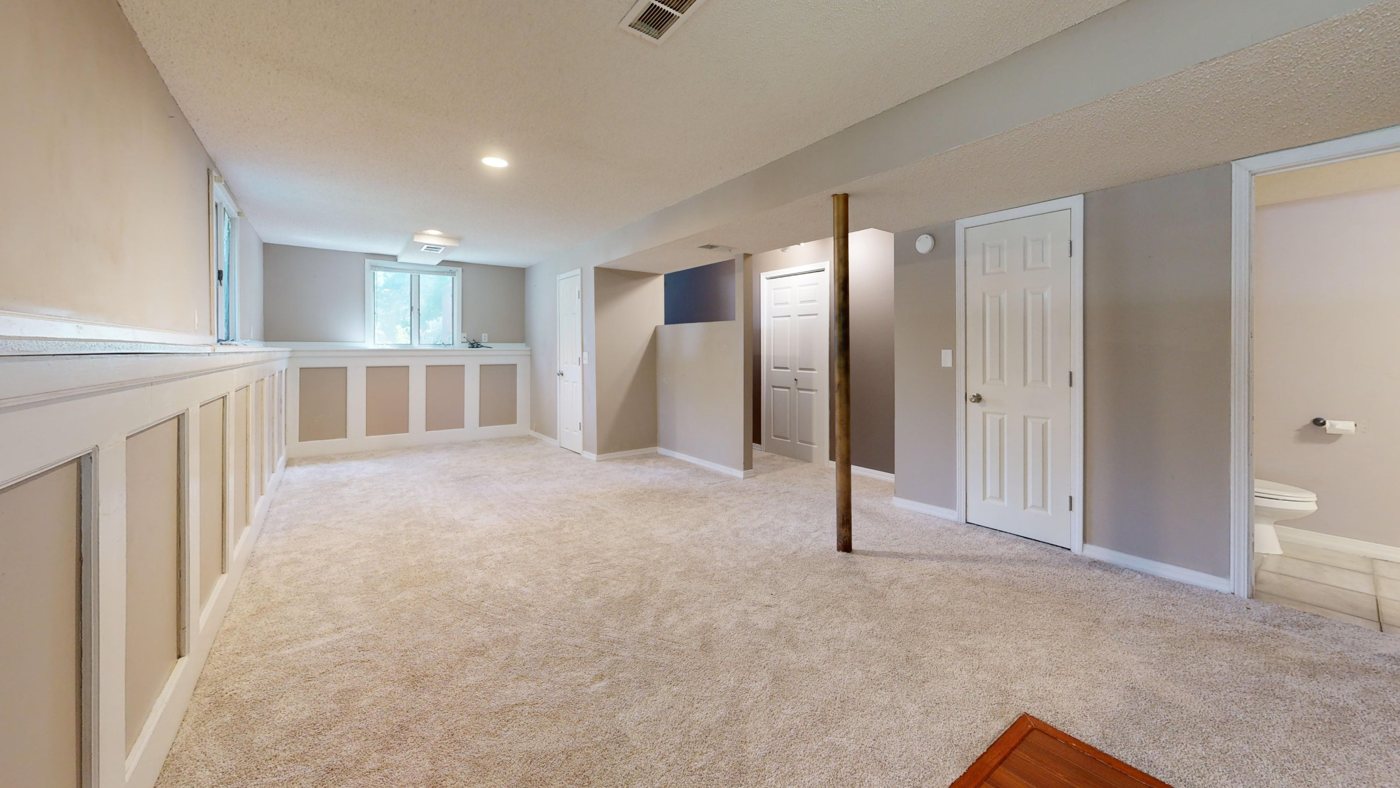
What basement finishing includes
Basement finishing turns bare concrete, open joists and storage clutter into rooms you can use every day. We handle the framing, drywall, and trim and finish work, and we plan the layout around how you want to use the space.
Here is what that covers:
- Framing for walls and room layouts
- Drywall hanging and finishing
- Trim and finish work
- Family rooms and home offices
- Guest suites
We do carpentry and general contracting. We do not do electrical or plumbing work ourselves, but we can coordinate licensed electricians and plumbers for the job. Scope depends on the project, and your itemized quote shows what we are including. We go over it with you at the free consultation.
If you are not sure what your basement needs, a free consultation at your home is a good place to start. We look at the space with you and tell you what is realistic before you spend anything.
Is your New Hampshire basement a good candidate?
Most basements can be finished, but a few things decide how much work it takes. We look at ceiling height, moisture, access and heating before we quote.
These are the things to think about:
- Ceiling height. Measure under beams, ducts and pipes, not only in the open middle of the room. The low spots set the real height.
- Moisture. Damp walls or floors need a fix before anything gets covered up. More on that in the next section.
- Egress. How someone gets out in an emergency matters most when the room will be a bedroom, and the rules come from the code your town enforces.
- Heating and cooling. A finished room needs heat in winter and a way to keep it from feeling damp in summer.
- Stairs and access. Steep or narrow stairs affect how you use the room and how materials get down there.
A problem on this list does not always rule out finishing. It changes the plan and the price.
Moisture and water: what to fix before you finish
Moisture is the one problem that can ruin a finished basement. If water or damp air is getting in, drywall, trim and flooring will show it within a season or two, so it has to be dealt with first.
Signs worth pointing out when we visit:
- A musty smell
- White, chalky residue on concrete walls
- Stains near the base of the walls
- Water on the floor after heavy rain or snowmelt
- A dehumidifier that never stops running
Tell us about past leaks even if they seem fixed. Surface water often starts outside, with gutters, downspouts or the slope of the ground next to the foundation, and those are worth checking before any money goes into the inside.
Basements in older homes
We work on older homes, and their basements can hold surprises. We do not handle lead paint on older homes. If your house was built before 1978, we test for lead, and if it turns up we work with regulated contractors as needed. Tell us the age of your house when you call or at the consultation.
Permits and inspections in southern NH
Permit rules are set town by town. Many towns require a permit when a project creates new finished space or changes structure, so check with your town building department before work begins.
Bedford is one example. Its building code page lists creating new rooms or spaces, removing non-bearing walls and renovating rooms among the work that needs a permit, and it says the owner or agent must apply and obtain the permit first. The same page says the permit rules reach beyond structural work.
Each town has its own process and its own people to call. If your project needs a permit, we or one of our subcontractors can pull it. That includes electrical and plumbing permits when we coordinate those trades.
What affects the cost
Every basement is different, so the cost depends on the job and we do not post prices. After a free consultation at your home, you get an itemized written quote. These are the things that move the number, and each one shows up as a line on it.
| What changes the price | Why it matters |
|---|---|
| Size of the space | More area means more framing, drywall and finish work. |
| Ceiling height | Low or uneven ceilings take planning and can limit the layout. |
| Moisture work | Water and humidity problems get fixed before finishing starts. |
| A bathroom | It adds plumbing, and usually electrical and ventilation work too. We can coordinate a licensed plumber and electrician. |
| Egress | A bedroom may need a code-compliant way out. |
| Finishes | Flooring, trim, doors, lighting and paint vary a lot in cost. |
| Heating and cooling | Keeping the room comfortable can add to the scope. |
How the project runs, step by step
Every project starts with a free consultation and an itemized written quote, and we are fully insured the whole way through.
- Free consultation. We visit your home, listen to what you want and take measurements.
- A clear, itemized written quote.
- Permit, which we or our subcontractors pull where your town requires one.
- The build, with a clean site each day and updates as we go. That means framing, then drywall, then trim and finish work.
- A final walkthrough together. We review every detail and do not call it done until you are happy.
How long it takes depends on the size and scope of your basement. We go over the schedule with you when we give the quote.
Ideas that work in New England basements
A basement can do more than one job. Tell us what you need and we will plan the layout around it. Common uses:
- Family room
- Home office
- Guest suite
Basements get little daylight, so it helps to plan lighting early. It also helps to put quiet rooms, like an office or guest room, away from the mechanical room and the stairs.
Where we finish basements
We work across southern New Hampshire, including Salem, Windham, Derry, Londonderry, Bedford, Manchester, Exeter, Merrimack, Bow, Pelham, Portsmouth, Stratham, Candia, Auburn and Epping. If your town is not listed, call us.
Get a free estimate
Call (603) 665-0447 or send the estimate form. The consultation is free, the quote is itemized and in writing, and we are fully insured.
To help us give you a useful answer, tell us:
- Your town
- The rough size of the basement
- What you want to use the space for
- Any past water or damp problems
- The age of your house
Basement finishing FAQ
How much does it cost to finish a basement in NH?
It depends. Every basement is different, and the cost turns on size, ceiling height, moisture work, whether you add a bathroom, and the finishes you pick. We do not post set prices. After a free consultation we give you an itemized written quote so you can see each cost.
Do I need a permit to finish my basement in New Hampshire?
Permit rules are set town by town. Many towns require one when a project creates new finished space or changes structure. Bedford, for example, lists creating new rooms or spaces among the work that needs a permit and says to get it before work starts. Check with your town building department before work begins. If your project needs a permit, we or one of our subcontractors can pull it. That includes electrical and plumbing permits when we coordinate those trades.
Is my basement a good candidate for finishing?
Most are. We look at ceiling height, moisture, access and heating before we quote.
How long does a basement finishing project take?
It depends on the size and scope of the basement, and on whether there is moisture to deal with first or a bathroom to add. We go over the schedule with you when we give your written quote after a free consultation.
Can you finish a basement that has had moisture problems?
Moisture has to be dealt with first, because finishing over a wet or damp basement just hides the problem for a while. Tell us about any past leaks or damp spots at the free consultation, and we look at them with you before we quote.
Do I need an egress window in a finished basement?
It depends on how you use the room and on the code your town enforces. A room used for sleeping is the usual concern. We talk it through at the consultation, and your town building department can confirm what applies to your house.
Do you do the electrical and plumbing work?
We do not do electrical or plumbing work ourselves. We do carpentry and general contracting, and we can coordinate licensed electricians and plumbers for your basement project. We or our subcontractors can pull the electrical and plumbing permits when we coordinate those trades.
Can you finish a basement in an older home with lead paint?
We do not handle lead paint on older homes. If your house was built before 1978, we test for lead, and if it turns up we work with regulated contractors as needed.
What can I use a finished basement for?
A family room, home office or guest suite. Tell us what you need and we will plan the layout around it.
Will a finished basement add value to my home?
It adds usable living space, and that can matter to buyers. How much it adds depends on your market, the quality of the work and how the space is finished, so we do not quote a percentage. A local real estate agent or appraiser can tell you more for your street.
Which towns do you serve?
Salem, Windham, Derry, Londonderry, Bedford, Manchester, Exeter, Portsmouth, Stratham, Candia, Auburn, Epping and nearby towns across southern NH. If your town is not listed, call us.